History
How Muay Thai got its ring
From palm-leaf law codes and royal guards to the first permanent ring, gloves, the Bangkok stadiums, Olympic recognition and Pattaya's television era.
Choose a night at the ring ↗Quick answer
Muay Thai grew from older Siamese bare-hand fighting, long tied to soldiers and the royal court, into a ring sport with codified rules in the early twentieth century. Siam's first permanent ring was built in 1921, and gloves replaced rope-bound hands after a death in the ring. The sport was at the height of its popularity in the 1980s and 1990s and won full IOC recognition in 2021. Pattaya's arena belongs to its television-led chapter.
Old roots, contested stories
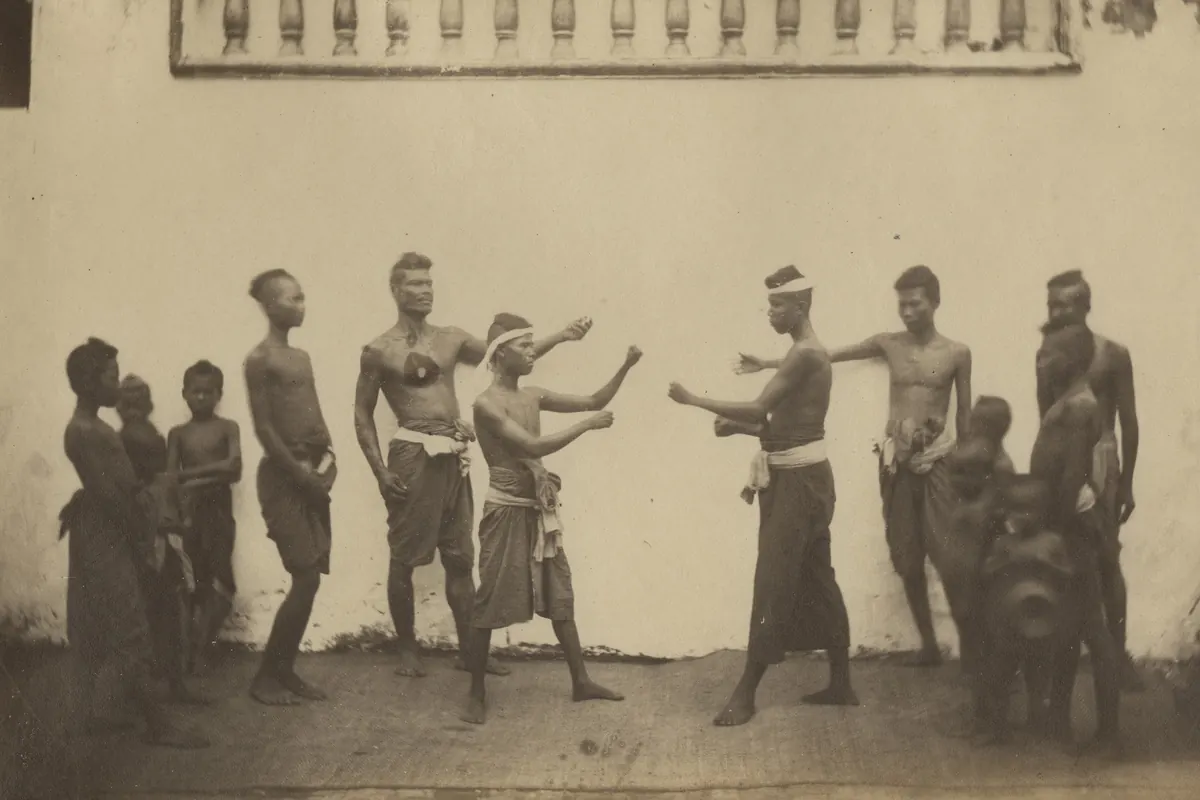
Wikipedia traces the word muay to old palm-leaf manuscripts, among them the Mungrai law enacted in 1296, and describes the fighting art being taught to royalty in the Sukhothai era; Prince Ram Khamhaeng was sent at thirteen to study it with other subjects. It is worth reading that history with care. The account now taught as standard was largely codified in the late twentieth century, when Muay Thai became a national sport and cultural symbol, and scholars have described parts of this royalist and nationalist history as an invented tradition.
A Chonburi connection
One early record touches Pattaya's own province. The Royal Chronicle of the North documents King Uthong bringing Muay boxers from the city of Sri Phalo, now in Chonburi province, to the city-state of Ayodhya during his reign from 1253 to 1289. Sri Phalo was one of two towns of the Dvaravati period that stood near the mouth of the Bang Pakong River. So when a fight card runs on the Chonburi coast today, it does so in a province that sent fighters inland more than seven centuries ago.
Soldiers and the royal court
For centuries the art was bound to war and to the throne. From 1455, under King Borommatrailokkanat, boxers formed part of the King's Guard Department, and skilled fighters were picked from competitions to guard the king and patrol the palace. The royal chronicles even record a king fighting in disguise: in 1702 King Suriyenthrathibodi joined the boxing at a temple fair outside the capital and won both his matches to loud applause. Boxing at temple fairs and festivals was a familiar public entertainment.
The legend of Nai Khanom Tom
The best-known story belongs to Nai Khanom Tom, celebrated as the sport's founding hero. According to the folklore, after the fall of Ayutthaya in 1767 he was taken captive to Burma and fought before the Burmese king, defeating ten opponents in a row. Several scholars argue the legend is mythological rather than historical and probably emerged or was amplified in the twentieth century, during Thailand's nation-building. Either way, it is commemorated every year on 17 March, Muay Thai Day, with a festival and a wai khru ceremony.
From courtyard to curriculum
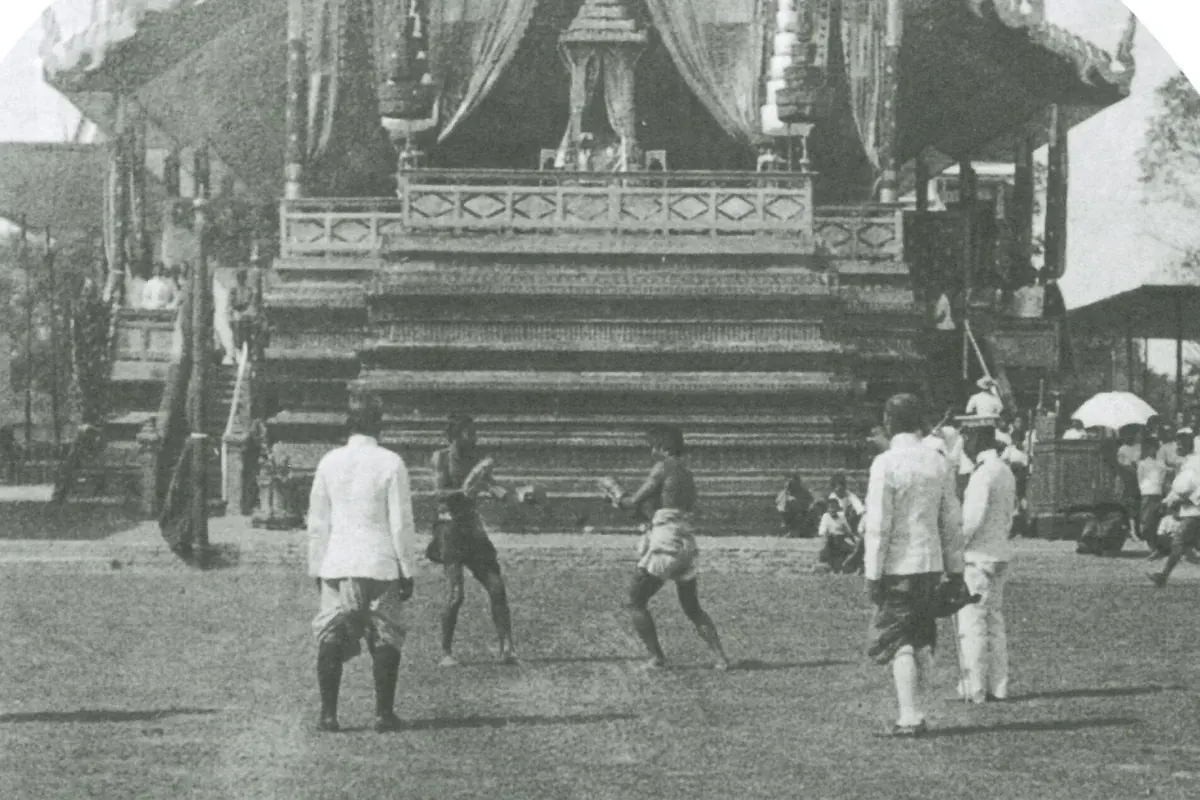
King Chulalongkorn's accession in 1868 ushered in a golden age for muay. He held nationwide tournaments, set up a royal boxing centre and gave the noble title of Muen to the winners of matches. In 1887 he founded the Department of Education, and Muay Thai became a subject in the national curriculum for teacher training and the royal military academy. In 1910, at the funeral of one of his sons, fighters came from the provinces, and the three best, from Lopburi, Khorat and Chaiya, were honoured; their regions later gave names to codified regional styles.
Rings, rules and gloves
The modern ring arrived quickly. Siam's first permanent ring was built at Suan Kulap College in 1921, and in 1923 the Suan Sanuk Stadium, near Lumpinee Park, set up the first international-style ring, with three ropes and red and blue padded corners. Under King Rama VII rules were codified, referees introduced and rounds timed. Fighters had long bound their hands in rope, but after a death in the ring they were made to wear gloves. Around then the name Muay Thai came into common use, and the older style became known as Muay Boran.
Stadiums, boom years and the world stage
Bangkok's Lumpinee Boxing Stadium opened on 8 December 1956 and became a symbol of modern Muay Thai. The sport was at the height of its popularity in the 1980s and 1990s, when top fighters drew big purses and the stadiums drew big crowds. Abroad, the amateur federation IFMA was inaugurated in 1993, Muay Thai joined the World Games programme in 2017, and on 20 July 2021 the IOC General Assembly granted full recognition to IFMA and Muaythai.
Pattaya's chapter
Pattaya itself is young as a resort. It was a fishing village until the 1960s, and tourism began during the Vietnam War, when American servicemen arrived on rest and relaxation leave; it was granted city status in 1978. The arena's promotion belongs to the sport's television era. Broadcast on Thai TV from its own stadium, it is credited with modernising how Muay Thai is presented, with three-round bouts and ring girls borrowed from Western promotions, an evening built as much for the camera as for the room.
Read next: Muay Thai night: worth it?
Sources